
Yes, the Brando of the title does refer to the one and only Marlon Brando, one of cinema’s most famous and idiosyncratic performers. This isn’t a standard biopic of Brando as an iconic, but you might wish it was instead of what it actually is.
“Waltzing with Brando” is told from the perspective of Bernard Judge, an architect sent to Tahiti to build a hotel for Brando, and later to build a house for Brando on a remote and hard to reach island surrounded by coral reefs and largely isolated from the outside world, since this was during the period of Brando’s life where he became taken with the idea of living outside of society. It’s a true story, and this architect, Bernard Judge, wrote a memoir in 2011 titled “Waltzing with Brando: Planning a Paradise in Tahiti,” which served as the source material for the adapted screenplay written by Bill Fishman, who also directed the film.
Fishman has been around in the industry since the ‘80s, but you’re unlikely to be familiar with his name. Most of his work has been in the music video space. He has made a couple of other feature films over the years, but we’re talking about junk like “Car 54, Where Are You?” which has the distinction of being one of the lowest rated movies on IMDb with a 2.6 out of 10. That’s lower than “Jack and Jill,” “Cats,” and most Uwe Boll movies.
With that context in mind, it helps explain why absolutely everything about the execution of this film feels not just off but outright wrong. There’s major potential for a film telling this particular true story, but “Waltzing with Brando” botches that potential every step of the way. At a foundational level, if we strip the film to its base components, it’s a comedy-drama that is never once funny and attempts no major dramatic conflict until the final 20 minutes, which as you might guess, is too little, too late and leave no impression. Not a single joke lands in the entire film, and most of its attempts at humor lack the construction to even be considered jokes — this is the type of bad comedy where putting a bunch of naked people on screen and then having the main character say verbatim, “boy, everybody’s naked,” is meant to pass for humor. We’re talking sub-“that just happened” type non-humor.
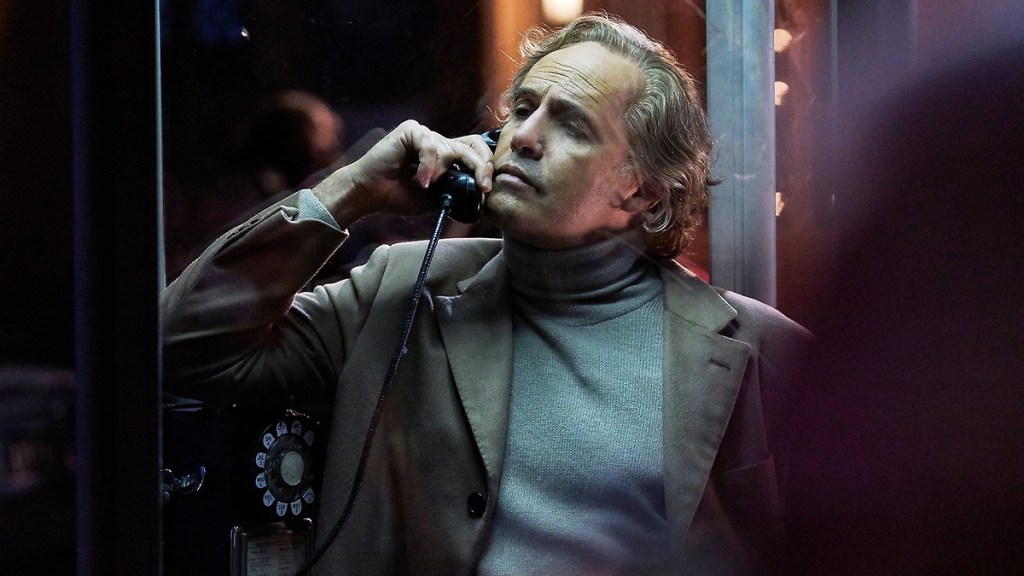
The author of the source material and the main character of the film are one in the same, which goes some distance toward explaining why this story lacks a real air of credibility. I can’t know what really happened between Judge and Brando—nobody can but the two of them, and they’re both dead—but their interactions and other elements of the story smack of major exaggeration and embellishment. Beyond that, Judge does not make for an interesting or engaging protagonist. There is no drama to this character; that is, until the last act when the film suddenly decides to shoehorn in some familial conflict that is 1: not believable, 2: cliche as hell, and 3: resolved almost immediately with zero consequence.
This flimsy lead character is played by Jon Heder of” Napoleon Dynamite” fame. Having not seen a ton of his work, I don’t have much of an overall opinion on Heder as an actor, but he comes off absolutely horribly in this. Whether he’s aiming for drama or comedy in a given scene, nothing lands, and even his mannerisms and silent reactions earn the blanket description of “bad acting,” but if Heder wanted to blame it all on bad directing, I would be tempted to believe him. And he certainly isn’t helped by the script, which has him and the rest of the cast spewing some of the worst dialogue I’ve heard in a long, long time. We’re talking about the kind of dialogue where a character will turn and say, and I quote: “Earth is our most precious resource and we must protect it vigorously,” apropos of nothing in a tight closeup. Nobody talks this way, it’s lazy and ham-fisted.
Heder is also sabotaged by the script and the director by being saddled with copious interruptive narration. This movie wants to be “The Big Short” or “The Wolf of Wall Street” so badly and frequently has Heder turn and speak directly to the camera, and they even try to get cute with it by having other characters inconsistently be able to hear him or by having his daughter jump in to narrate in one scene that it particularly cringe-inducing. Fishman does not have anywhere near the writing or directing chops to pull off this kind of fourth-wall breaking and it leaves the film feeling even more amateurish that it already does in every other regard.
“Waltzing with Brando” also gives tremendous amounts of ammunition to the those who say that narration is a crutch. In the hands of a master like Martin Scorsese, narration can be a great boon to a project, but Fishman uses it as an excuse to cram in lazy exposition and make info-packed asides that would otherwise be difficult to integrate into a dialogue scene. But also, the exact opposite problem is all true, meaning that a significant amount of narration is spent telling the audience things that were already made clear; it’s redundant in the purest sense of the word. Breaking the show-don’t-tell rule constantly is already bad enough, but breaking the show-don’t-tell rule and then having the main character narrate the same information again right afterward is really pushing it.
There are even outright contradictions between the narration and what we’re shown visually. Take, for example, a piece of narration where Judge describes Brando’s favorite bar as being, quote, “The worst bar in the world,” and says that it’s full of criminals and junkies and whatnot… meanwhile, what we’re shown is a perfectly pristine and lively tiki bar that’s full of happy, model-handsome people singing and dancing and having a grand ol’ time—there’s a complete disconnect that’s impossible to miss.
Worst of all is when the narration is used to undo what little drama there is in the film. Far too deep into “Waltzing with Brando,” the first hint of conflict finally arises when Judge’s wife thinks she saw him cheating on her, which leads to her getting mad and storming off. Now, even as cliche as this conflict is, instead of doing anything with it, the narration immediately kicks in with Judge saying, “I had a lot of explaining to do, but she didn’t leave me.” Really? The first whiff of conflict finally happens over an hour into the movie, and you instantly resolve it off-screen with narration as your cheat-code band-aid? That’s beyond laziness. It’s insulting. Similarly, the film introduces the idea that Judge is in major financial debt due to this project, but then it again does nothing with this conflict. We never see the effects of this nor any strain from it, and it ultimately doesn’t matter in any way whatsoever.
Given Fishman’s background in music videos, you might hope that at least the soundtrack would be good, but no, it’s awful. It’s full of cheesy music cues at every turn used as crutches to transition between scenes that lack natural beginnings and ends, and these song choices aren’t creative or interesting, they’re auto-pilot temp-sounding tracks.
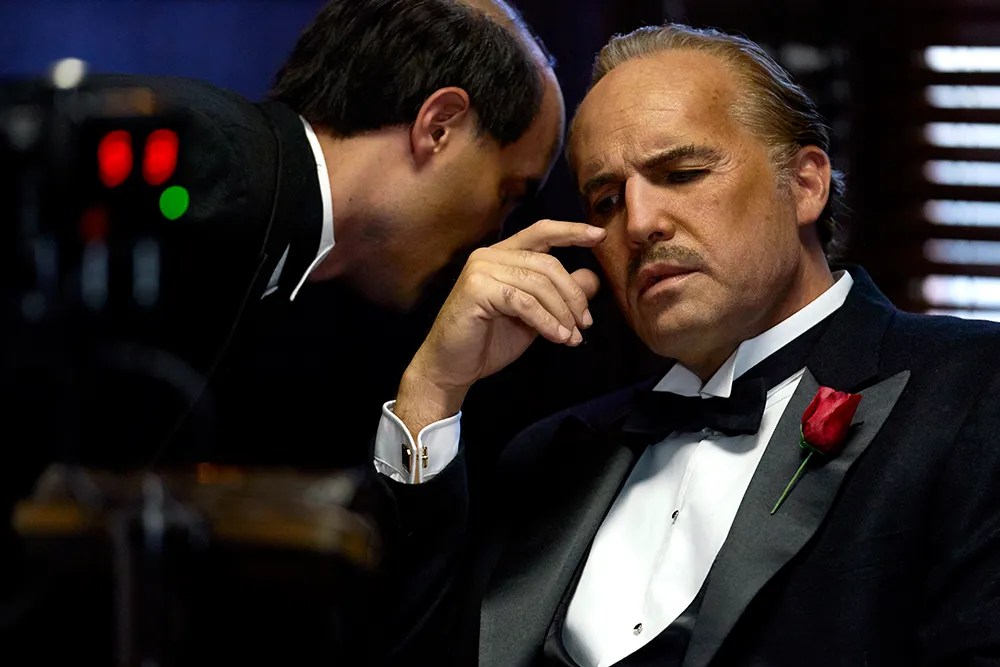
But okay, let’s talk Brando. In the film, Marlon Brando is played by Billy Zane, and I imagine there will be some people who end up giving “Waltzing with Brando” a passing score and call Zane the film’s sole saving grace. But I think that’s a stretch. Zane does come off significantly better than his surroundings, but he by no means saves the film. He bears a strong resemblance to Brando naturally, and the genuinely impressive makeup, costuming, and hairstyling complete the transformation. When all done up, he really does look like a dead ringer for Brando, and there might even be a moment or two where you end up doing a double-take and wondering if that’s archival footage of the real Brando before realizing that, no, it’s still Billy Zane.
The film capitalizes on this by having scenes where some of Brando’s most famous movie moments are recreated: a scene from “The Godfather,” one from “Apocalypse Now,” etc. These moments succeed in making Zane look exactly like Brando, but they are complete asides that don’t advance the plot. Sure, Brando is supposedly using the money from these roles to fund the construction that Bernard Judge is leading, but the recreated scenes themselves are nothing but kitschy gimmicks.
So yes, he’s the spitting image of Brando, but I have to ask… so what? That is nowhere near enough to hang an entire film on. With a dynamite script that lived up to the clear “Wolf of Wall Street,” “Social Network,” “Big Short” aspirations of the film, then it’s a look and a performance that would serve and elevate the material, but that’s not what we have here. Instead, Zane’s performance is in service of complete junk.
More importantly, when evaluating Zane’s performances in isolation, he has no dramatic meat to sink his teeth into. This is a fluff role that finds him doing a Brando impression without giving him any conflict to wrestle with. The film makes the choice of presenting Marlon Brando as a nearly mythic figure, which robs the character and the overall film of any and all drama to found in Brando as a human being. Moreover, the film is afraid to criticize Brando to even the slightest degree. It only presents Brando in a glowing light, as if he’s the best person to ever live, which was extremely far from the truth. Brando both had major issues internally and caused major issues for many other people. He hurt people and did a lot of damage, but you would never know it by watching this film; you would think he was a virtuous God among men who was a little quirky but only cared about advocating for civil rights and protecting the environment.
Here’s a quote from a BBC report written by Emma Jones looking back at the making of Brando’s “The Last Tango in Paris” 50 years later. Referring to Brando’s co-star Maria Schnieder, Jones writes, “She remembered what happened on the day of filming that scene, in which her character is raped by Brando’s, using butter as a lubricant.” Then a quote from Schnieder herself: “That scene wasn’t in the original script. The truth is it was Marlon who came up with the idea. They only told me about it before we had to film the scene and I was so angry… I felt humiliated and to be honest, I felt a little raped, both by Marlon and by Bertolucci. After the scene, Marlon didn’t console me or apologise … Marlon said to me: ‘Maria, don’t worry, it’s just a movie,’ but during the scene, even though what Marlon was doing wasn’t real, I was crying real tears.”
The making of “The Last Tango in Paris” is a part of “Waltzing with Brando,” but instead of portraying the reality and criticizing Brando, it instead paints the shoot as a super happy time where Brando hit it off with his co-stars and everyone had a great time. It’s not only disrespectful to Schnieder, it’s also just bad writing. There’s no drama, there’s no conflict, there’s nothing, and that holds true for the entire film.
I think I’ve ranted more than enough about this movie, and that’s without even getting into the weird stuff, like how there’s a scene where Judge encounters what appears to be a demon woman with glowing eyes, and then the next scene seems to confirm that it really was a demon, and then it’s never mentioned again and has no relevance on the plot whatsoever. What was that doing in there? Did Judge really stick that made up bullshit in his memoir? And then Fishman really decided to include it? Seriously? What are we doing here?
I give “Waltzing with Brando” a 1 out of 10. It is a terribly made, cringe-inducing puff piece, nothing more.
 samkench.com
Leave a comment