
Even though the 2021 “Candyman” rebootquel had plenty of problems and was ultimately just okay, director and co-writer Nia DaCosta still made a good first impression with me—I have yet to see her debut feature “Little Woods” but it’s on my radar. I found myself hoping for a longer director’s cut of “Candyman” and planning to check out whatever her next movie was. That ended up needing to wait, because her followup project was “The Marvels,” and I have no intention of ever watching another MCU movie.
But now, after her foray into the massive blockbuster sphere, DaCosta is returning with a significantly smaller (though still expensive-looking) outing with “Hedda,” a revisionist adaptation of the 1800s Henrik Ibsen play “Hedda Gabler.” I’m familiar with Ibsen’s plays “A Doll’s House” and “The Master Builder,” but the plot of “Hedda Gabler” was unfamiliar to me going in.
The basic setup is that the titular Hedda Gabler (played here by Tessa Thompson putting on a mostly convincing though occasionally distracting British accent) throws a big party with manipulative machinations. Among those present at the party are her new husband, a current affair, her former lover, that ex’s new partner in both writing and romance, and a professor that everyone wants the attention of. This central love quadrangle (or maybe love pentagon?) provides the main dramatic heft of the film, but it takes a bit too long for all of the players to be placed on the board.

The opening act of the film is the weakest and largely feels flat and lifeless. The film seems to overestimate what intrigue would be generated by its flash-forward framing device that teases a crime and mystery before jumping back to start the story proper. While not entirely ineffective, this opening framing device comes across as a cliche more than a strong hook. A lack of compelling dramatic conflict, humor that misses more often than it hits, and an odd breathy recurring audio cue that feels tonally at odds with the film and sounds like it’s straight out of a bad horror movie all left me thoroughly unimpressed with the opening act; the first half hour or so did nothing to pull me in dramatically. Thompson does a fine job, and Hedda herself is certainly a big personality, but I didn’t find her particularly interesting as a character. However, she stands head and shoulders above the rest of the characters in terms of intrigue. That is, until Nina Hoss as Eileen Lovborg enters the film.
Hoss single-handedly elevates the film the moment she appears, not only because she’s a great actor but also because she brings with her some juicy dramatic conflict that was lacking throughout the opening. That’s not to say there is no drama in the first half hour of the film—there is—it’s just not that compelling. The Lovberg character, however, is extremely compelling. And this character also marks one of DaCosta’s major departures from the source material. In the original play and in the many past film adaptations of it, Lovberg has always been male.
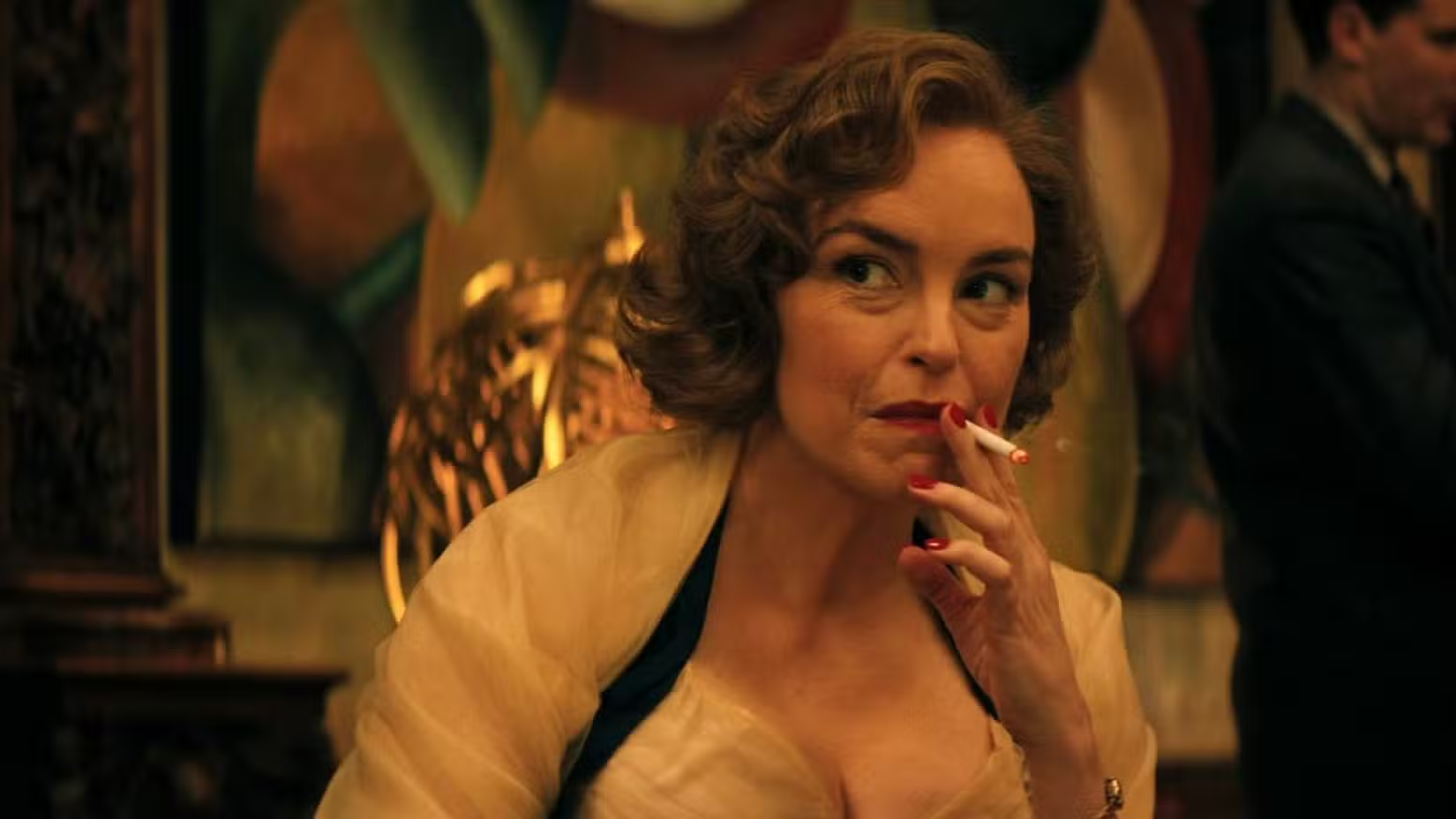
The decision to make Lovberg a woman (and, by extension, to make Hedda bisexual) is a major and meaningful change, far from being the sort of frivolous gender-swap seen in projects like 2016’s “Ghostbusters.” Given the olden time period in which “Hedda” is set, Lovberg being a woman who is an author and a teacher is already notable and unwelcome enough to stir up conflict with other characters in the film, never mind the fact that she’s an out-of-the-closet lesbian during an extremely unaccepting time. This change also plays well into the film’s themes and makes the romantic entanglement that Hedda has with her husband, her affair (a man), and Lovberg all the more dramatically complex.
Lovberg and the dramatic tension she has with her ex, Hedda, and her new love, Thea (Imogen Poots), keeps the film crackling along throughout the entire middle section… which makes it even more of a shame when the movie leaves her on the sidelines for the climax and instead pivots to center on a less developed and less interesting character pitted against Hedda instead. Sadly, some of the goodwill that the strong middle of the film earns is squandered by this rushed climax that is certainly thematically appropriate but can’t rise above feeling cliche.
“Hedda” was sent to me as a for-your-consideration screener this awards season, and it’s clear that the film is aiming for Oscars attention, but will it get it? Well, I think it’s a bit of long shot but it’s certainly possible. Does it deserve Oscar attention? Actually, I would say yes. Nina Hoss absolutely deserves a best supporting actress nomination, which is the acting category that I’ve found to frequently have the fewest great candidates in any given year (a problem with the roles available, not the performers). You could also send a best costume design nomination Lindsay Pugh’s way for her work on the film, and it would be well deserved.
 samkench.com
Leave a comment