
Set in Tucumán, Argentina in the in the 2010s, “Belén” tells the important true story of a young woman (who ends being known by the pseudonym of Belén, played by relative newcomer Camila Plaate) who went to the hospital in pain and, instead of finding the help she was looking for, was arrested and sent to prison. While in the hospital for pelvic pain, she denies being pregnant when asked, but the hospital insists there was either an abortion or a miscarriage in the bathroom. The police leap to far-flung conclusions involving a botched abortion followed by the drowning of the supposed fetus in the toilet water, leading to Belén being arrested on the spot while she’s still on the gynecology table with her legs spread. As a result, she ends up spending years in prison with a much longer sentence looming overhead, despite the fact that there’s no real evidence for the infanticide charges against her. What supposed evidence there is, the fetus, outright disappears (if it was ever there to begin with) and is inconsistent from report to report. It’s clearly a rigged setup with her being considered guilty from the word “go” by a judicial system that wishes to prosecute all abortion but disguises it by concocting an infanticide and scapegoating an innocent 24-year-old woman.
As you might guess, this is a staunchly feminist film, and it tackles the subject of abortion and reproductive right head-on while also taking a multi-level look at the roles of the courts, the police, and the hospitals in this system that enables reproductive violence against women. While the film may be set in Argentina in the recent past, its themes and message are just as relevant to the modern U.S. and many other countries around the world. These are vitally important themes to explore and messages to showcase in this day and age, and to the film’s credit, its messaging is clear and effective throughout. Unfortunately, the execution comes up short in other regards—namely, the plotting, the directing and editing of certain moments, and especially the character work, both on a script and performance level.

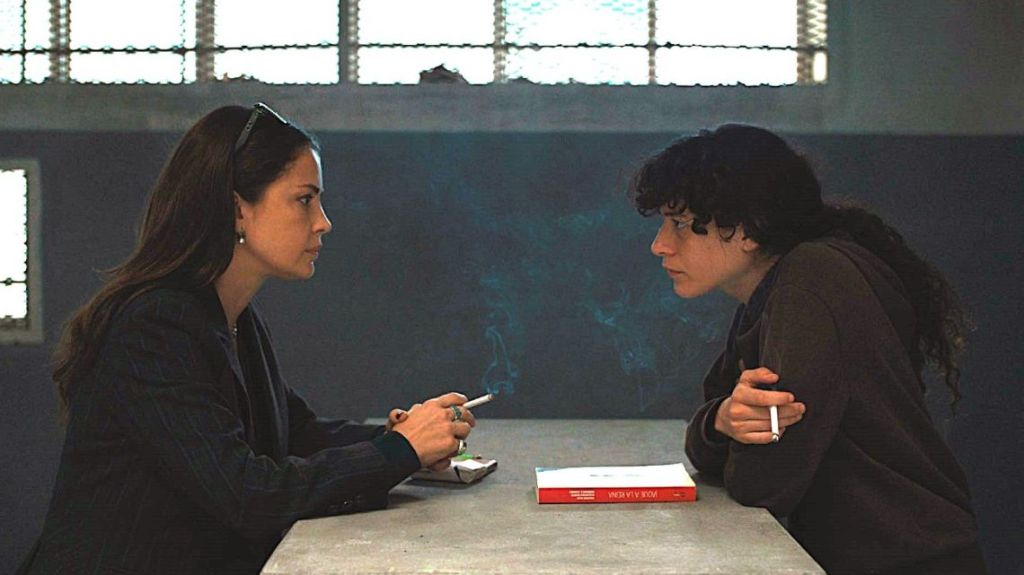
“Belén” was adapted from the non-fiction book “Somon Belén” written by Ana Correa and directed by Dolores Fonzi, who also served as one of the film’s four adapted screenplay writers and played the lead role of Soledad Deza, the lawyer who takes on Belén’s appeal case after her original lawyer all but threw the trial. Fonzi has been around as an actor since the ’90s, but this is only her second film as director after 2023’s “Blondi,” which she also co-wrote and starred in. I’m sure her heart was in the right place when tackling this story, but one has to wonder if there was some ego involved in deciding to play Deza herself and in deciding to position the lawyer as a film’s protagonist instead of focusing more on Belén. Sure, Deza is the more active character, unconfined by the walls of a prison, but she isn’t the more interesting or compelling character out of the two. An even-handed split would have served the narrative well, but Deza is given far more characterization, an entire family life at home, and I would estimate more than quadruple the screentime of the titular character.
It certainly doesn’t help that Fonzi comes up short with this performance. For many scenes, her performance is enough to get the job done—no more, no less—but whenever the big dramatic scenes come around that demand tears or intense feelings, she hides her face behind her hands or arms and merely pantomimes the emotions instead of genuinely expressing them. While definitely not a performance that I would call bad, it is one lacking in commitment and that leaves a lot to be desired in the crucial moments, resulting in the potential emotional impact feeling muted. And by contrast, the character of Belén is given short shrift.
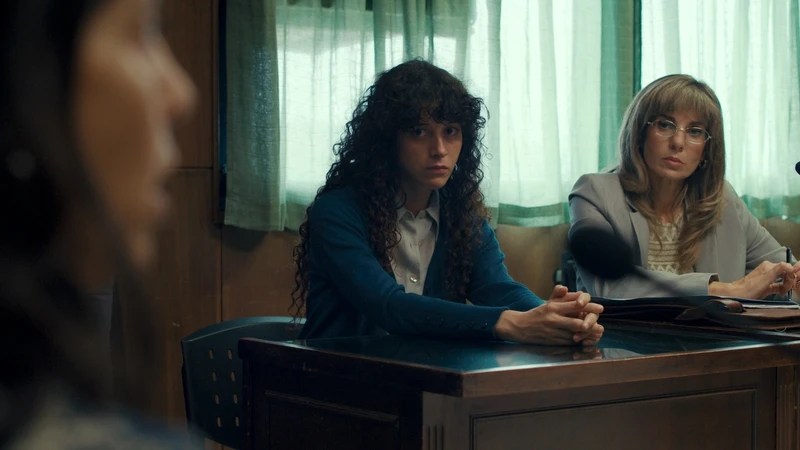
The opening scene is truly nightmarish and generates enormous sympathy for Belén, but she sadly receives little to no characterization beyond her victimhood. The audience learns virtually nothing about who Belén is as a person outside of what happened to her on this one horrible night. We don’t know what she does for work or school or what her interests and passions are, she doesn’t have a fleshed out personality, and she isn’t even allowed to express any opinions that go further than simply reacting to the developments of the case and wishing for anonymity. She has a family that is technically present in the film but, unlike Deza’s family, they aren’t properly introduced or developed, only fleetingly passing through scenes. Camila Plaate does what she can with the role and does effectively showcase truer, deeper emotion than Fonzi, outshining the lead despite having significantly less material to work with. However, with this lack of characterization, the emotion can’t come from a singular perspective rooted in character and is instead more generalized.
None of the film’s other characters leave an impression. Or, I should say, none of the others leave a good impression. Laura Paredes as Deza’s assistant Barbara and Salvador Lemos as Deza’s son Lauti both come off poorly—the former because she’s largely used as comedic relief in a film that is never once successfully funny, the latter because he’s written to be the dumbest, most oblivious child on Earth and is not believable in the slightest—but neither are the fault of the performers, it’s the script and direction that do them dirty.

Speaking of the failed comedic relief, this is one area where the film really drops the ball. As a director, Fonzi presents the dramatic scenes well enough, but the film wobbles to the point of falling over whenever it attempts a tonal shift or a stylistic shakeup. Every so often, the film endeavors to slide from prestige drama into a more fun or comedic sequence, but the execution is beyond awkward. These are the kinds of scenes that you could imagine working if styled with the rapid editing and clever framing of Edgar Wright circa the Cornetto trilogy. But instead, they’re shot the exact same way as the non-fun/funny scenes only with distracting, ill-fitting music (including “Gangnam Style” in one particularly grating sequence) and with strange editing that never finds a workable rhythm and is always too languid for scenes that are clearly meant to have the energy of fast-paced montages.
There are also tonal shifts in the opposite direction. There are two brief moments when the drama is replaced by horror in the form of nightmare dream sequences, both involving blood emerging in the prison shower with Belén. The idea has potential, but again, the execution leaves these moments toothless. These scenes are too brief to have any impact—just like a non-nightmare sequence involving a brick thrown through a window, which the film cuts away from so quickly that the audience isn’t allowed to feel the weight of the moment nor shown the emotional responses of the characters involved. At times, the pacing of the film feels like it is speeding through a checklist of things that happened in the true story without properly dramatizing the events or their consequences.
The script is another area that comes up shy. While some scenes work quite well and give an impression of the full potential that could have been reached with the project—such as the opening sequence or the talkshow scene where Deza debates an anti-abortion figurehead—other aspects of the screenplay feel underbaked. The actual casework that Deza is doing throughout the film, for example, is left vague and weightless in favor of focusing more on her own rote family drama. We get moments where she’s attempting to get important files or retracing Belén’s path, but these scenes are largely truncated to the point of breaking the ever-important show-don’t-tell rule of screenwriting. We don’t really see Deza retrace Belén’s path in a meaningful way; we’re told that’s what she’s doing when she explains it to her assistant.
Moreover, major developments in the plot largely feel like they just happen on their own rather than being the result of our protagonist’s actions. For example, the crowd of protesters supporting Belén grows over the course of the film, and in reality, I’m sure Deza was instrumental in making that happen, but in the film, it feels almost entirely unrelated to what we actually see her doing. The same holds true for so many of the film’s other major plot points, which are largely robbed of their inherent drama due to poor plotting and pacing.
The film’s thematic messaging is its biggest strength, but even this area isn’t without one major stumble. Religion is present in countless scenes and is a fixation that the film clearly wants to explore. There are crucifixes on the walls of the school and courthouse, Deza is religious and prays, and there are heated religious arguments involving Deza’s own daughter and others. It would seem as if “Belén” is building toward the main character being forced to reckon with her faith in the face of a system that uses her own religion to justify this violence against women… but no. That would be insightful, worthwhile social commentary. Instead, the film seems afraid to critique religion or confront the way it’s utilized and is content to simply present religion as an ever-present entity in these characters’ lives without arriving at a cogent point in regard to it. Overlooking the inextricable link between the protagonist’s religion and that same religion’s role in the system she’s fighting against is more than a missed opportunity—it undercuts the film’s overall message and strips the lead character of an inherently dramatic internal conflict.
This is an important true story that deserves to be told, but “Belén” is far from being the ideal telling of it.
 samkench.com
Leave a comment