
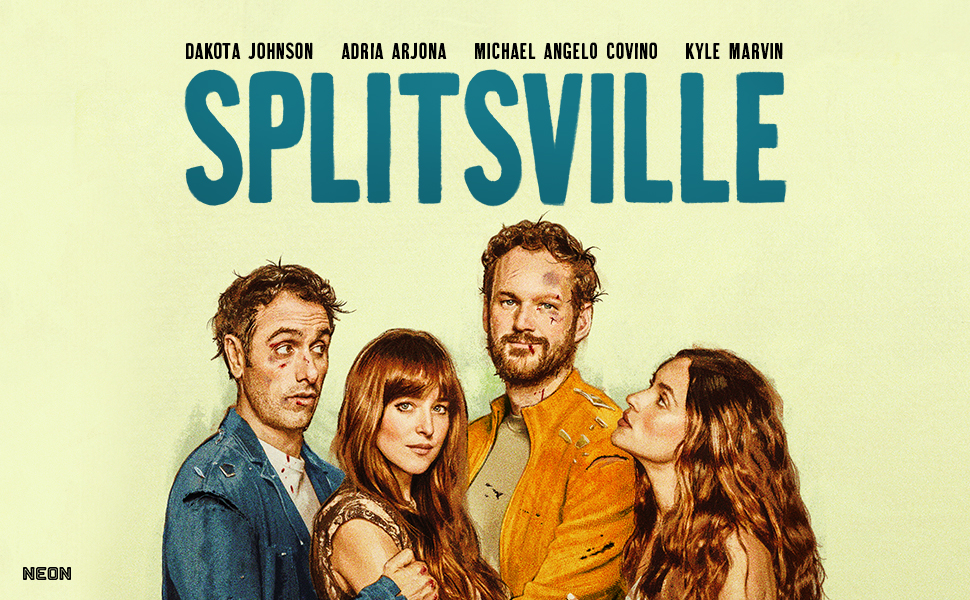
2025’s “Splitsville” is a romantic comedy that takes aim at infidelity, polyamory, divorce and the intersection of the three in modern romantic relationships. The tangled-up quadruple at the broken-heart of the film is played by Kyle Marvin, Michael Angelo Covino, Dakota Johnson, and Adria Arjona. All four served as producers on the film, and you can tell that it’s a passion project for everyone involved. Despite having a rather familiar base plot that could fit into the big studio rom-com mold, (even the polyamory angle is a bit overplayed at this point), “Splitsville” manages to feel indie in all the right ways.
Along with producing and playing the two male leads, Covino and Marvin co-wrote the film together, and Covino directed it. This was the same multi-hatted dynamic they shared on 2019’s “The Climb,” which is Covino’s only prior directed feature film. In both films, Covino and Marvin play best friends, and it’s clear that this dynamic holds true behind the scenes (both films also involve cheating, but let’s hope that part doesn’t carry over into reality). The two have enormous amounts of chemistry together and give confident, dialed-in comedic performances. With rather small bodies of acting work outside of their own projects, “Splitsville” doubles as a great vehicle to showcase their considerable talents. In this way, I was reminded of “Thunder Road,” a brilliant launching pad for the excellent Jim Cummings.
Adria Arjona impresses as well with an interesting character and solid comedic timing. Her character, Ashley, goes through a whirlwind of flings after deciding to divorce Carey (Marvin), which brings a bevy of fun supporting characters into the film. “Splitsville” gets a surprising amount of comedic mileage from a masseuse side character played by David Castañeda, Charlie Gillespie made me laugh every time he popped up as a moron attempting to find a calling in life, and Nicholas Braun shows up in what amounts to a meatier-than-usual cameo role that feels like his Cousin Greg character from “Succession” decided to become a mentalist.
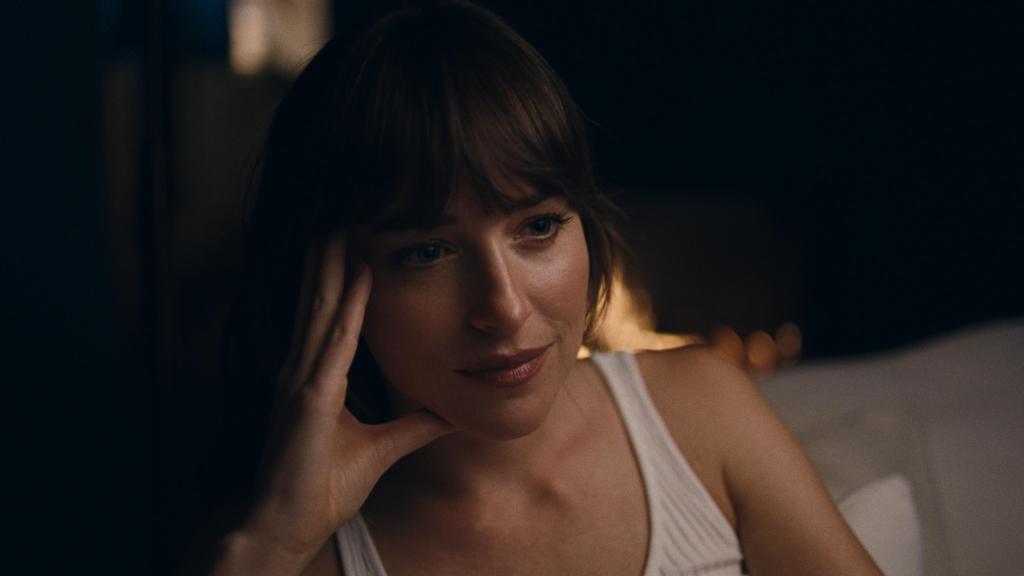
Unfortunately, Dakota Johnson doesn’t come off as well as the rest of the cast. I don’t have anything against her in general—I thought she was great in “Suspiria” but unmemorable in the handful of other roles I’ve seen her in, and I don’t plan on watching projects like “Madam Web” or the “Fifty Shades” movies. While I wouldn’t go so far as to call her performance in “Splitsville” bad, it does come across as flat and a bit dull. Given that the rest of the cast delivers such fun and energetic performances, Johnson holding to the same downbeat tone and cadence for practically all of her lines sticks out like a sore thumb. It’s like she’s on downers while the rest of the cast is on uppers. It’s hard to escape the feeling that this character could have been significantly funnier with different casting.
One of the film’s taglines refers to “Splitsville” as “an unromantic comedy.” While it would be wrong to say there’s absolutely no romance to be found in “Splitsville” at all, it is true that it eschews the saccharine vibes typically associated with the genre. In place of heartfelt lovey-dovey scenes is a whole lot more comedy with a focus on bigger, more over the top sequences than you usually get in this genre, like a hilarious scene involving goldfish on a rollercoaster and an extended fight scene that is truly one of the year’s action highlights (more on that later). This tradeoff works really well for me as someone who has enjoyed a few standard romcoms but isn’t necessarily a fan of them in general. On the other hand, I could see those who do love standard romcoms being left cold by “Splitsville” when it doesn’t deliver what they might go in expecting.
Comedy is front and center in “Splitsville,” and your overall enjoyment of the film will almost entirely hinge on whether or not you’re on its wavelength. The film’s sense of humor is pretty specific, and it goes for a mix between coming off as fairly realistic at times while being gleefully heightened and absurd at other times. It’s a tricky balance, and I think it largely works, though I wouldn’t be surprised to find that some viewers are pulled out by the less grounded moments.
The inciting incident and subsequent opening credits sequence serve as an effective barometer to gauge whether or not the film’s style of comedy is for you. I try to be hyper-sensitive to spoilers, so even though I’m only going to describe what happens in the opening scene, I’m still going to provide a spoiler warning here since it is a surprising moment if you go in blind. For one of the film’s couples, Carey and Ashley (Marvin and Arjona), what begins as some naughty canoodling while driving on a roadtrip turns into a brush with death. Their swerving causes a horrific accident for another driver on the road that results in a fatality, and it’s this close call with mortality that leads to their initial breakup. While there’s a world in which a scene like this could be played dramatically, “Splitsville” plays the cause and execution of this car crash so over the top that I found it hysterically funny. The opening credits that immediately follow further affirmed that I was on this film’s wavelength: While being broken up with, Carey runs away from the relationship, and this common emotional reaction is instead made literal, with Carey sprinting for miles and miles and miles through fields, forests, and bodies of water. If this opening sequence doesn’t sell you on the sense of humor of “Splitsville,” then you may as well turn the film off there as it simply isn’t going to be your kind of thing.

While not every joke in “Splitsville” landed for me, the hit-rate was solid. There’s a high volume of jokes, and the type of humor spans an impressive range from dialogue- and character-based humor to visual and slapstick humor. It’s great to see a modern comedy utilize the broader comedic possibilities of the medium when so many comedies of recent years draw the line at simple dialogue-driven humor. The editing also stood out as notably good, and it really helps drive home certain moments of visual humor by finding the perfect moment to reveal a gag with a clever cut.
The huge fight scene that serves as the centerpiece of the film was a wonderful surprise for me. It impresses not just as a creative comedic set-piece but also as a genuinely great action set-piece that finds these two best friends destroying a home and each others bodies in ridiculously over the top fashion. The fight choreography is heightened but believable, there’s a good escalation throughout, it’s packed with memorable gags (both of the fight and comedic variety), it’s shot with clarity and creativity, and it somehow manages to fit into the universe concocted for the film without feeling out of place despite being the only full-on fight scene.
What makes the whole thing extra impressive is the fact Covino and Marvin did all of the stunts themselves, and they certainly didn’t hold back. It’s not often that you see a director throw themself down the stairs for real (I mean, I did it when making “The Briefcase,” but that’s hardly the same thing). Covino and Marvin’s commitment to the physicality of the scene is admirable. Even in such strenuous circumstances, these two keep up the funny banter throughout the fight and find creative moments of comedy, like when they both decide that using knives is a step too far or when they pause to rescue some imperiled fish.
It’s a surprising state of affairs when one of the year’s best fight scenes is hidden inside the middle of a romantic comedy, but that’s what we have here. As a complete package, “Splitsville” is a fun time that has me eager to see what else Covino and Marvin have in store.
 samkench.com
Leave a comment