
“No Other Choice” is South Korea’s submission to the best international feature film category at the 2026 Academy Awards, and I’ll tell you right now, it’s a lock for one of the five nomination spots. If you want my predictions, I’ll call it now that the real International Oscar category is a race between “The Secret Agent,” “Sentimental Value,” “It Was Just an Accident,” and “No Other Choice,” with “All That’s Left of You” being a potential dark horse candidate, though that’s definitely more of a long shot than the others. And judging by the way the winds are blowing and the industry vibes I’m privy to, I think it’s really going to come down to “Sentimental Value” vs. “No Other Choice” for the crown.
This review is entirely spoiler-free, so have no fear if you haven’t had the chance to see the film yet, you are safe here.
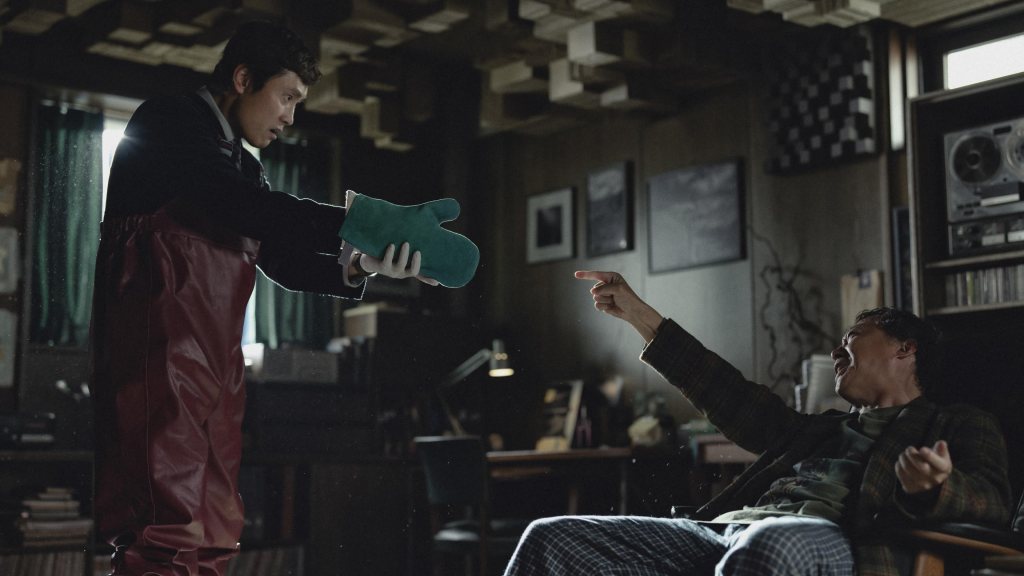
The great Lee Byung-hun stars as Yoo Man-su, a family man who loses his job in the paper industry after American businessmen get involved and conduct mass layoffs, which leads to the first of many name-drops of the title (this script revels in concocting scenarios for various characters to naturally slip in “I had no other choice”). When trying to get a new job that pays enough to support his family, he faces stiff competition and resorts to essentially becoming a serial killer that specifically targets the other people qualified for the position to make himself the only candidate.
It’s a fun and clever premise that is positively dripping with social commentary. Capitalism is a broken system that will literally drive people to murder. That’s the permanently timely and socially relevant starting point for this concept, and even better, the film isn’t content to sit back and ride that strong central theme all the way to the finish line, instead expanding and digging deeper on that thematic territory. I’m sure many will compare “No Other Choice” to “Parasite” since it’s another South Korean film conveying similar social commentary, and they do both strike a somewhat similar tonal balance between thriller and comedy, but I don’t think there’s much point in comparing them beyond that — except where the Academy is concerned, since “No Other Choice” could well become the second South Korean film to take home an Oscar.
Park Chan-wook was the filmmaker that first sparked my passion for South Korean cinema. Way back in middle school, I came across the “Oldboy” hammer fight out of context on YouTube and thought it was the coolest thing I had ever seen. I watched that one scene over and over again until I was finally able to see the entire film, and when I did, it expanded my adolescent brain’s understanding of what cinema could be. At that point in time, it was the best film I had ever seen (and it still lands extremely high up on my list of the top 250 best films ever made). I began seeking out and watching any South Korean film I could get my hands on, which of course included all of Park Chan-wook’s other films.
It also included many Lee Byung-hun films, and I’m a huge fan of the guy. His forays into American cinema haven’t fared quite as well, but “I Saw the Devil,” “A Bittersweet Life,” and “The Good, the Bad, and the Weird” are all certified classics in my book. As is “Joint Security Area,” which saw him working with Park Chan-wook for the first time back in 2000. “No Other Choice” is only their second feature film together, though they did collaborate on one of the segments of the “Three… Extremes” horror anthology, with strong results.
I was used to seeing Lee Byung-hun play dramatic, tough, cool characters, so it brought me great delight to see him absolutely nail the comedic elements of this role. There’s still plenty of drama for him to sink his teeth into, and he shines there as usual, but he also especially impressed with killer physical comedy chops and perfectly dialed-in little facial expressions and mannerisms that make moments so much funnier than they would be otherwise. The specific way he slips down some stairs, attempts to walk nonchalantly under pressure, or leans to the side to get the sun out of his eyes are all such brilliant comedic performance details. Just like with Brad Pitt in “Burn After Reading” or Ryan Gosling in “The Nice Guys” and “Barbie,” Lee Byung-hun is another suave leading man that should be allowed to go full goofy more often. “No Other Choice” has a hilarious script to begin with, and Lee Byung-hun’s performance elevates the comedy.

Though it feels deeply rooted in the present day and in South Korean culture, “No Other Choice” is actually an adaptation of an American novel from 1997, which further speaks to the unfortunate universality and timelessness of its themes. That novel is “The Ax” by Donald E. Westlake, which was previously brought to the screen in 2005 by Costa Gavras of “Z” fame. For “No Other Choice,” Park Chan-wook co-wrote the adapted screenplay with a handful of collaborators, including Canadian actor and writer Don McKeller, who also co-created and co-wrote the television series “The Sympathizer” with Park Chan-wook, which is also worth watching, by the way.
“No Other Choice” has a great script that really elevates the fundamentals while streamlining the setup and crafting opportunities for Park Chan-wook to get wild and creative in the director’s chair—there are several moments in the film that aren’t strictly necessary and seem to be in there for no other reason than they’re just good old fashioned fun, and that can be wonderful sometimes. I was particularly impressed by the script’s numerous ingenious set ups and payoffs. Every worthwhile payoff demands a proper setup; that’s a basic tenet of screenwriting, but far too often, either the set up, the payoff, or both are mishandled or telegraphed too obviously. A solid set up that slips past without the audience clocking it as a set up in the moment is oh so satisfying (especially for the screenwriter part of my brain), and “No Other Choice” is chock full of them.
But for as good as the script is, Park Chan-wook is on a whole different plane of existence in terms of directing. A couple of films back, I began referring to him as a cinemagician, as so many of his shots and sequences have the astonishing and beguiling effect of a great magic trick. And nowhere is that more apparent than in “No Other Choice.” Every shot is not only striking and dynamic in varied ways but also cleverly conceived and masterfully executed. There are countless shots and sequences in “No Other Choice” that will leave you scratching your head if you attempt to suss out precisely how they were pulled off. This is the work of a master filmmaker not just excelling at his craft but also taking the time to show off a little while he’s at it.

I still believe “Oldboy” is Park Chan-wook’s best movie overall, but “No Other Choice” does find him at the absolute top of his game as a visual stylist. In this way, I’m reminded of the trajectory of Wes Anderson (odd comparison, I know, but stick with me). “Moonrise Kingdom” and “Rushmore” are my favorite Anderson films, but there’s no denying that works like “Grand Budapest Hotel” or his Roald Dahl short collection display a further refinement of his signature aesthetic and represent the peak of the Wes Anderson style. That’s a similar case to what we have with Park Chan-wook, where I find “Oldboy,” “Sympathy for Mr. Vengeance,” and “The Handmaiden” the stronger overall films, whereas “Decision to Leave” and “No Other Choice” represent the absolute pinnacle of the Park Chan-wook style, even if they don’t quite hit that perfect sweet spot for me that those aforementioned films do.
Now, don’t let me be misunderstood, that’s not meant as any indictment of the script, performances, or anything else in “No Other Choice,” because it is exceptionally strong in all regards. I just get the feeling that there’s just a little something missing—some tiny component that would really tie everything together and leave me calling “No Other Choice” an unabated masterpiece. I’ve had a tough time trying to put my finger on exactly what that is, but it ultimately has to do with the way things are paced and wrap up in the third act. The actual ending is phenomenal, deepening the social commentary and putting the thematic cherry on top, but the immediate lead up to that ending felt just a bit rushed, like certain moments that should have been explored were instead skipped over or streamlined, and like certain plot threads weren’t given enough attention to feel fully earned or resolved. That’s not to say that the third act completely drops the ball or that it isn’t still satisfying, because it is. However, it is really the ONLY aspect of “No Other Choice” that doesn’t live up to the exceedingly high bar set by the rest of the film. I’m curious if a second watch would leave me feeling differently about the third act, and I do find myself wanting to watch it again already.
 samkench.com
Leave a comment